
THE ELLIPSOGRAPH OR ARCHIMEDES’ COMPASS
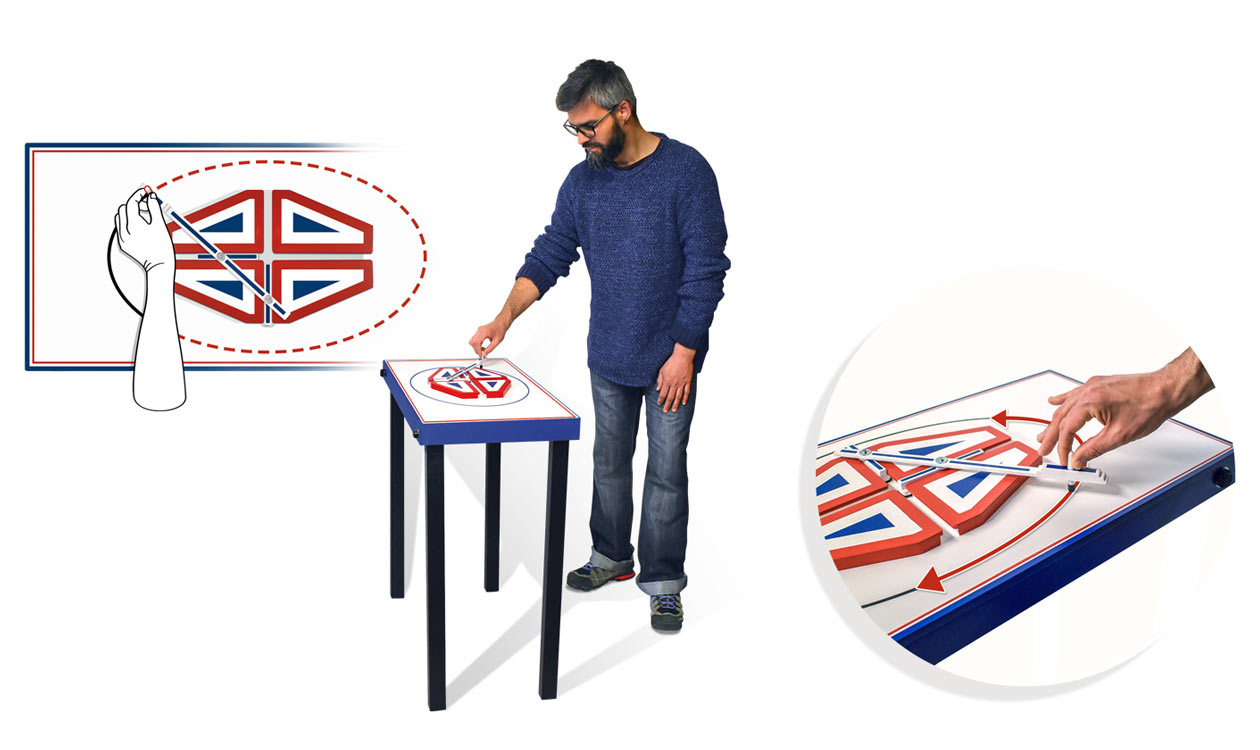
The ellipsograph is a mechanical device used to draw ellipses with a continuous motion.
It consists of two perpendicular straight grooves through which two sliders move. These sliders are attached to a rod with pins, which can rotate as the two pieces slide along the grooves, thereby drawing an ellipse.
The ellipse is one of the four conic sections. The others are the circle, the parabola, and the hyperbola. Planets, for example, describe elliptical orbits around the sun. The ellipse is a closed curve of great importance and is widely used in mathematics, surveying, astronomy, architecture, and engineering for cutting or drawing materials.
Read more
Although ancient Arab mathematicians and Greek geometers were already familiar with the ellipsograph, it was Leonardo da Vinci (1452–1519) who first reintroduced it to Europe, demonstrating its function by creating oval wheels for his planetary clocks. The first to patent it was the English architect and inventor Edward Burstow (1805–1875), in 1873.